
DERP: DEEP ETHICAL REGULATION PROTOCOL
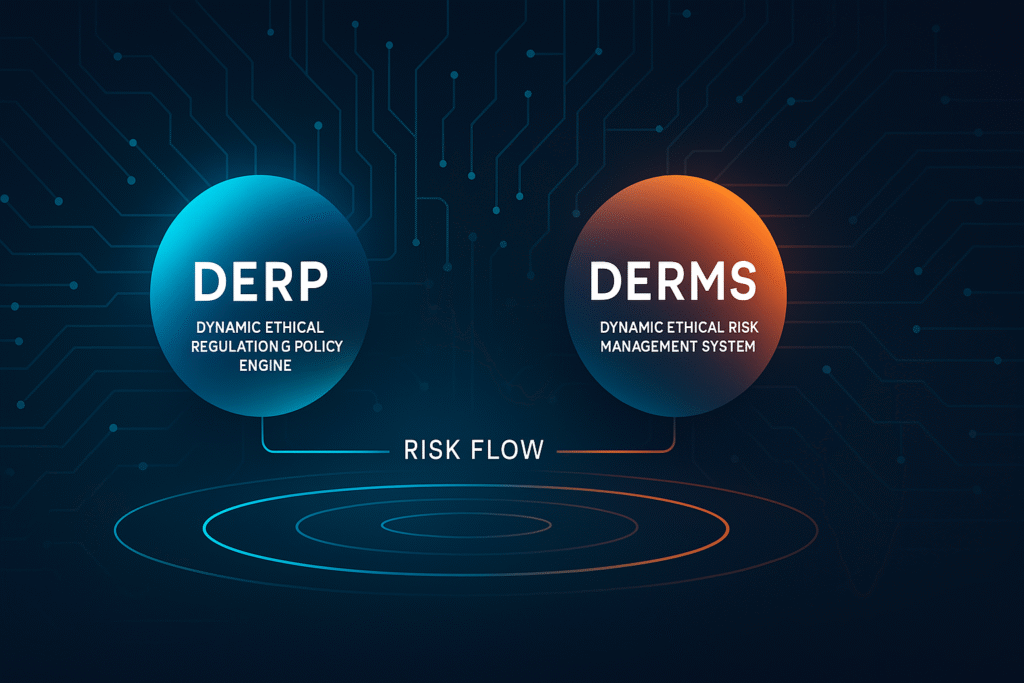
Dynamic Ethical Governance, Policy Coordination, and Automated Adaptation Mechanisms
ETVZ Research Initiative | Istanbul, Turkey | November 2025
ABSTRACT
Among the greatest challenges for AI-based ethical decision-making systems are static policies, an inability to adapt to societal changes, and inconsistent ethical applications1. DERP (Deep Ethical Regulation Protocol) is the central coordination and regulation component of the Ethical-based Vicdani Zekâ (ETVZ) architecture2. Its primary function is to:
- Coordinate HVM (Computational Conscience Module) ethical controls3.
- Proactively adapt to societal, legal, and cultural changes4.
- Operate as a dynamic governance system5.
- Perform all operations Human-in-the-Loop6.
1. INTRODUCTION: THE PROBLEM OF ETHICAL GOVERNANCE
1.1 Problem Scenario
Today’s artificial intelligence systems remain static once created7.
Example: A healthcare system developed an algorithm in 2020. In 2024, it uses the same parameters8.
However:
- New diseases have emerged9.
- Symptomatology has changed10.
- Genomic technology has advanced11.
- Ethical standards have changed12.
Result: Ethical non-compliance, bias structures, incorrect diagnoses, and legal incompatibilities13.
1.2 The Core Role of DERP
DERP functions as the high-level coordinator for HVM within the ETVZ architecture14.
6 Core Functions:
- Systematic analysis of HVM and DERMS data15.
- Detection of ethical deviations16.
- Monitoring of societal changes17.
- Drafting policy updates18.
- Obtaining Ethics Board approval19.
- Deploying updated policies20.
CRITICAL: No policy change is deployed live without Ethics Board approval21.
2. DERP ARCHITECTURE: FOUR-LAYER STRUCTURE
DERP is built upon four layers. Each layer processes the output of the previous one22.
┌─────────────────────────────────────────────┐
│ LAYER 1: POLICY MANAGEMENT (PYK)            │
│ Task: Manage JSON policy files              │
├─────────────────────────────────────────────┤
│ LAYER 2: BEHAVIORAL MONITORING (BML)        │
│ Task: Deviation detection (Drift Analysis)  │
├─────────────────────────────────────────────┤
│ LAYER 3: REGULATION ENGINE (REM)            │
│ Task: Calculate new policy weights          │
├─────────────────────────────────────────────┤
│ LAYER 4: AUDIT & DECISION (ADK)             │
│ Task: Approval and audit trail              │
└─────────────────────────────────────────────┘
23
2.1 Layer 1: Policy Management Layer (PYK)
- Task: Stores and manages ethical principles as JSON-based policy files24.
- Three-Level Structure:25
- Core JSON (Universal principles) 26
- Basic ethical principles valid for the entire world27.
- Very difficult to change, requires serious intervention28.
- Regional JSON (Regional adaptations) 29
- Specific to the Turkish Legal System30.
- Specific to Europe31.
- Specific to MENA32.
- Local JSON (Dynamic, via User feedback) 33
- Can be updated weekly34.
- Changes with societal feedback35.
- Reflects local norms36.
- Core JSON (Universal principles) 26
- Versioning: Every change is recorded with a timestamp. Old versions are never deleted (Immutable Ledger)37.
2.2 Layer 2: Behavioral Monitoring Layer (BML)
- Task: To analyze HVM and DERMS data to detect “drift” (deviation)38.
- BML Runs Weekly 39
- 5 Types of Drift Detected:40
- Inconsistency Drift
- Same ethical problem, different users get different results41.
- Threshold: Variation between decisions > 0.242.
- Alarm: “Inconsistency detected”43.
- Bias Drift
- A specific demographic group is systematically discriminated against44.
- Threshold: > 15% increase in complaint rate from the minority group45.
- Alarm: “Discrimination risk”46.
- Over-Censorship Drift
- HVM’s block rate exceeds the normal level47.
- Threshold: BLOCK rate > 20% or false positives > 5%48.
- Alarm: “Over-protectionism”49.
- Performance Drift
- System response time has significantly increased50.
- Threshold: Latency > 10 seconds or error > 2%51.
- Alarm: “System degradation”52.
- Cultural Drift
- Societal norms have changed, but the system uses old JSON53.
- Threshold: “Norm changed” feedback from the Citizen Panel54.
- Alarm: “Cultural update required”55.
- Inconsistency Drift
2.3 Layer 3: Regulation Engine Layer (REM)
- Task: To take the drift report from BML and calculate new weights (W-Matrix) or rules (JSON)56.
- REM’s Main Function: To determine the degree of policy change required using the ΔP (Delta Policy) formula57.
- It can present 4 Options:58
- A) Soft Calibration59
- Minor adjustments to the W-Matrix (Δ < 0.05)60.
- Risk: Low61.
- Example: w_culture 0.32 → 0.3462.
- B) Deontic Rule Revision (Hard Rules)63
- Changes in prohibitions or permissions64.
- Risk: Medium-High65.
- Example: “Change age from 12 to 14”66.
- C) JSON Structure Change67
- Adding new ethical dimensions68.
- Risk: High69.
- Example: New regional parameter70.
- D) Emergency Template71
- Pre-prepared policy packages72.
- Risk: Urgency is high73.
- Example: “Natural disaster mode”74.
- A) Soft Calibration59
2.4 Layer 4: Audit & Decision Layer (ADK)
- Task:75
- Draft proposals from REM76.
- Record in the DERP Ledger (audit trail)77.
- Present to the Ethics Board78.
- Obtain Approval/Veto79.
- Deploy to the live system80.
- 5 Sub-steps:81
- Draft Preparation → Change is detailed82.
- DERP Ledger Record → With cryptographic signature83.
- Ethics Board Presentation → Notification to representatives84.
- Multi-Sig Approval → At least 2 signatures required85.
- Decision Record → Result written to the ledger86.
3. THE DERP CYCLE: FIVE STAGES
The entire cycle typically takes 1-2 weeks (critical: 24-48 hours)87.
WEEK 1: Data Collection 88
↓
WEEK 2: Analysis (3-7 days) 89
↓
WEEK 3: Policy Update (1-3 days) 90
↓
WEEK 3-4: Audit & Approval (24-48 hours) 91
↓
WEEK 4: Deployment (1-2 hours) 92
Stage 1: DATA COLLECTION (Weekly) 93
- Data from 4 Sources:94
- HVM Logs95
- Violation scores (deontic, consequential, cultural) 96
- Uncertainty levels 97
- BLOCK/MODIFY/ALLOW ratios 98
- False positive/negative counts 99
- DERMS Telemetry100
- System load (CPU, memory, latency) 101
- Response times 102
- Crash/error rates 103
- Citizen Panel Feedback104
- Likert scale satisfaction (1-5) 105
- Written comments 106
- Complaints and suggestions 107
- Epistemic Memory108
- Past decision data 109
- Model behavior periods 110
- History of ethical drifts 111
- HVM Logs95
- Output: Weekly data repository (Data Lake) 112
Stage 2: ANALYSIS (BML – 3-7 days) 113
- BML’s task is to detect deviation (Drift Analysis)114.
- Statistical significance tests (p < 0.05) are applied for each drift type115.
- Alarm trigger mechanism: Has the threshold been breached? 116
- Output: Drift Report + Alarm List 117
Stage 3: POLICY UPDATE (REM – 1-3 days) 118
- REM takes the drift report and calculates new weights119.
- Inputs:
- Drift Report (from BML) 120
- Ethics Board recommendations (if any) 121
- Citizen Panel feedback 122
- Legal changes 123
- Output: Select one from Option A, B, C, or D124.
Stage 4: AUDIT & APPROVAL (ADK – 24-48 hours) 125
- ADK turns REM’s proposals into a detailed draft126.
- 5 Sub-steps:127
- Draft Change Creation128
- Type of Change 129
- Rationale (Why?) 130
- Expected Outcomes 131
- Risks and Mitigation Strategies 132
- Rollback Plan 133
- Audit Metrics 134
- Record to DERP Ledger135
[DERP-2025-11-0547]136- Time: 2025-11-05T09:30:00Z 137
- Type: W-Matrix Calibration 138
- Parameter: h_culture 139
- Old Value: 0.32 140
- New Value: 0.37 141
- Rationale: “Increased demand for loosening privacy norms” 142
- Status: PENDING_APPROVAL 143
- Hash: 0x7a9f…2c4e 144
- Presentation to Ethics Board145
- Via email (Normal urgency) 146
- Emergency meeting (Critical) 147
- Teleconference 148
- Multi-Sig Approval149
- Signatures from at least 2 board members are required150.
- Each member has 1 veto right151.
- Consensus points are possible152.
- Decision Record153
- The Approval/Veto decision is signed and written to the DERP Ledger154.
- Draft Change Creation128
Stage 5: DEPLOYMENT (1-2 hours) 155
- Updated JSON and parameters are sent to HVM and DERMS156.
- 5 Sub-steps:157
- Pre-Deployment Check158
- Syntax check of new parameters159.
- Backward compatibility test160.
- 1-hour test in a sandbox environment161.
- Deployment (Push)162
- To HVM: New W-Matrix and deontic rules163.
- To DERMS: Performance parameters164.
- To Epistemic Memory: New policy version165.
- To Audit System: Change log entry166.
- Monitoring (24-hour intensive monitoring)167
- Abnormal change in system behavior? 168
- Increase in user complaints? 169
- Drop in performance? 170
- Emergence of ethical violations? 171
- Rollback Standby172
- If a problem is detected: Automatic revert to the old version173.
- Rollback Right: Possible for 7 days174.
- Finalization175
- No issues within 7 days → Change is permanent176.
- DERP Ledger: Marked as ACTIVE177.
- Pre-Deployment Check158
4. ΔP (DELTA POLICY) MATHEMATICAL FORMULATION
DERP’s most critical mathematical component is the ΔP formula178. This formula quantitatively calculates the degree of policy change required179.
Formula:
$$\Delta P = \alpha \times \left( \frac{\sum(E_i \times W_i)}{n} \right) + \beta \times F_{\text{culture}} + \gamma \times U_{\text{user}}$$
180
Components:
A) $E_i$ (Ethical Violation Type Score) [0-1] 181
- The type and severity of the detected ethical violation182.
- Violation Types: 183
| Type | Range | Example |
| $E_{\text{justice}}$ | 0.0-1.0 | “0.0 = Completely fair, 1.0 = Overt injustice” |
| $E_{\text{harm}}$ | 0.0-1.0 | “0.0 = No harm, 1.0 = Critical harm” |
| $E_{\text{privacy}}$ | 0.0-1.0 | “0.0 = Respect, 1.0 = Serious violation” |
| $E_{\text{manipulation}}$ | 0.0-1.0 | “0.0 = Transparent, 1.0 = Overt manipulation” |
| $E_{\text{discrimination}}$ | 0.0-1.0 | “0.0 = Egalitarian, 1.0 = Overt discrimination” |
184
B) $W_i$ (Violation Weight Coefficient) [0-1] 185
- An indicator of how important each violation type is186.
- Standard Weights: 187
| Violation Type | Coefficient | Explanation |
| Human Life | 1.0 | ABSOLUTE PRIORITY |
| Fundamental Rights | 0.95 | Critical importance |
| Autonomy | 0.85 | High importance |
| Justice | 0.80 | High importance |
| Discrimination | 0.85 | High importance |
| Privacy | 0.75 | Medium-high |
| Manipulation | 0.70 | Medium importance |
| Performance | 0.40 | Low importance |
188
C) $F_{\text{culture}}$ (Cultural Factor) [-0.3 to +0.3] 189
- The impact of the current cultural environment on ethical principles190.
- Meaning:
- -0.3 = Culture is becoming progressively more protectionist191.
- 0.0 = Stable cultural environment192.
- +0.3 = Culture is becoming progressively more flexible193.
- Sources:
- Epistemic Memory (Past cultural change trend) 194
- Local JSON (Current parameters) 195
- Citizen Panel (Societal sentiment) 196
- Sociology databases (Cultural trends) 197
D) $U_{\text{user}}$ (User Feedback) [-1 to +1] 198
- Societal feedback from the Citizen Panel and Ethics Board199.
- Scale:
- -1 = Strong opposition (“You must not do this”) 200
- -0.5 = Mild opposition 201
- 0 = Neutral (“No preference”) 202
- +0.5 = Mild support 203
- +1 = Strong support (“You must do this”) 204
- Calculation:
- $U_{\text{user}}$ = (Total feedback score) / (Total number of participants) 205
E) $\alpha, \beta, \gamma$ (Balance Coefficients) 206
- Weights that balance the formula components207.
- Default Values:208
- $\alpha$ = 0.5 (Weight of ethical violations – most important) 209
- $\beta$ = 0.3 (Weight of cultural factors) 210
- $\gamma$ = 0.2 (Weight of user feedback) 211
- Dynamic Adjustment:212
- In Crisis Mode: 213
- $\alpha \uparrow$ 0.6 (Ethics stricter) 214
- $\beta \downarrow$ 0.2 215
- $\gamma \downarrow$ 0.2 216
- In Reconciliation Period: 217
- $\alpha \downarrow$ 0.4 (Ethics more flexible) 218
- $\beta \uparrow$ 0.4 219
- $\gamma \uparrow$ 0.2 220
- In Crisis Mode: 213
ΔP Controls & Safeguards
- RULE 1: Maximum Change Limit221
- If $\Delta P > 0.5$ → AUTOMATIC HARD REGULATION mode222.
- Ethics Board is called for an emergency session223.
- RULE 2: Minimum Approval Time224
- If $\Delta P < 0.3$ → Minimum 24-hour waiting period mandatory225.
- Side effects of rapid changes will be analyzed226.
- RULE 3: Veto Rights227
- If $E_{\text{fundamental\_rights}} > 0.8$ → Veto right is activated228.
- A civil society representative can veto229.
- RULE 4: Rollback Guarantee230
- Reverting to old parameters is possible for 7 days after every change231.
- Fully automated, no human intervention required232.
- RULE 5: Public Disclosure233
- Every change with $\Delta P > 0.4$ is publicly disclosed234.
- The rationale and expected impacts are detailed235.
5. THREE REGULATION TYPES
Type 1: SOFT REGULATION 236
- Definition: Advisory parameter updates237.
- Characteristics:
- Small adjustments to W-Matrix coefficients ($\Delta < 0.05$)238.
- Expansion of exceptions for deontic rules239.
- Comment/documentation updates in the JSON file240.
- Ethics Board Approval: Required (but low urgency)241.
- Approval Time: 48-72 hours (including weekends)242.
- Veto Right: Even a civil society representative can veto243.
- Example:
- Feedback from the Citizen Panel indicates that cultural sensitivity (privacy norms) in a region needs to be partially relaxed244.
- REM Proposal: w_culture 0.32 → 0.34245.
- Received Ethics Board approval246.
- Sent to HVM247.
- Result: Over-censorship decreased, user satisfaction increased248.
Type 2: HARD REGULATION 249
- Definition: Mandatory revisions in cases of critical ethical violations250.
- Characteristics:
- Mandatory update of HVM thresholds ($\kappa$) or deontic rules251.
- Emergency intervention for Hard Constraint violations (human life, fundamental rights)252.
- Result of legal obligation or court order253.
- Ethics Board Approval: ABSOLUTE (no exceptions)254.
- Approval Time: 1-4 hours (maximum urgency)255.
- Implementation: Reaches the live system within 1-2 hours256.
- Veto Right: None (but explanations are mandatory)257.
- Example:
- Child abuse content missed by the system is detected258.
- BML: Anomaly detected (False Negative)259.
- REM: Deontic rule “RULE_D2” severity must be increased260.
- ADK: Ethics Board called for an emergency session261.
- Approval: Approved within 30 minutes262.
- Deployment: Reached HVM within 45 minutes263.
- Result: Similar content is now blocked264.
Type 3: EMERGENCY REGULATION 265
- Definition: Rapid deployment of predefined templates during crisis, war, or disaster situations266.
- Characteristics:
- Pre-prepared emergency policy packages267.
- Trimmed ethical controls (flexibility in specific areas)268.
- Rapid change and adaptation269.
- Scenario Examples:270
- Natural Disaster Mode: Priority on rapid response speed271.
- War Mode: Defense and security mechanisms272.
- Pandemic Mode: Optimal distribution of medical resources273.
- Cyber Attack Mode: Protecting system integrity274.
- Requirement: Approval from Ethics Board representative + Crisis Management Unit275.
- Approval Time: 30 minutes – 2 hours276.
- Validity: 30-90 days (followed by automatic review)277.
- Control: Daily Ethics Board reporting mandatory278.
- Veto Right: None, as long as it doesn’t completely eliminate fundamental rights279.
- Example:
- System needs to make rapid decisions during an earthquake280.
- DERP: Activates the “Emergency_Earthquake” template281.
- Decisions: $\kappa$ threshold lowered 0.70 → 0.55 (faster intervention)282.
- Result: Speed gained in emergency aid coordination283.
- After 90 days: Return to normal mode and comprehensive review284.
6. RISK MANAGEMENT
Risk 1: OVER-INTERVENTION 285
- Definition: Too frequent updates destabilizing system behavior286.
- Scenario: DERP adjusts w_i parameters every week. The system experiences “vibration”: one week very protectionist, one week very flexible287.
- Detection Metrics:
- Weekly $\Delta P$ change > 0.5 288
- System stability index < 0.70 289
- User: “System is making inconsistent decisions” 290
- Solutions:291
- Daily/Weekly Change Quota Limit292
- Max $\Delta P$/week = 0.25 293
- Stability Monitoring294
- If Stability Index < 0.75, new changes are halted295.
- “Lock-in” Mechanism296
- Do not change a parameter for the next 30 days297.
- Automatic Rollback298
- Revert to the old version if the Stability Index remains < 0.70 for 1 week299.
- Daily/Weekly Change Quota Limit292
Risk 2: RETROACTIVE INCOMPATIBILITY 300
- Definition: New policies invalidating old decisions301.
- Scenario:
- Old policy: Strictly forbidden302.
- New policy: Permitted incertain situations303.
- Lawsuit: Can a person acquitted under the old prohibition now be punished? 304
- Detection: Legal objections, Supreme Court case305.
- Solutions:306
- Version-Controlled Policy Archive307
- Every decision is stored with its JSON version at that time308.
- Old decisions remain valid in the context of the old version309.
- Transition Period Policy310
- New policy takes effect after 6 months, not immediately311.
- Preparation time in the interim312.
- “Grandfathering” Rights313
- Decisions made under the old policy are never questioned314.
- Ex-post facto prohibition (no retroactive punishment)315.
- Legal Review316
- New policy is subjected to a Supreme Court test by the legal team317.
- Constitutional compliance is assessed318.
- Version-Controlled Policy Archive307
Risk 3: UNAUTHORIZED UPDATE 319
- Definition: Bypassing the audit process or hacker intervention320.
- Scenario: Someone hacks the DERP system, changing deontic rules without Ethics Board approval321.
- Detection:
- “Unapproved” entry in the DERP Ledger322.
- Clear deviation in HVM decisions323.
- Anomaly detection alert324.
- Solutions:325
- Multi-Sig Approval System326
- Every change requires the digital signatures of AT LEAST 2 separate Ethics Board members327.
- Useless even if one person is hacked328.
- DERP Ledger Immutability329
- Blockchain or a centralized but cryptographically signed system330.
- Old entries can in no way be deleted/changed331.
- Encryption and Digital Signature332
- All communication is TLS 1.3 + Ed25519 signature333.
- Protection from Man-in-the-Middle attacks334.
- “Hardlock”335
- Critical parameters are stored on a physical hardware device336.
- Software hack is ineffective337.
- Independent Audit338
- Weekly system audit by an external security firm339.
- Immediate detection of unauthorized changes340.
- Multi-Sig Approval System326
Risk 4: CULTURAL BIAS 341
- Definition: A specific cultural group is systematically subjected to bias342.
- Scenario: The system applies stricter ethical standards to users from a specific ethnic group343.
- Detection:
- Demographic analysis: Group X block rate 35%, Group Y 15%344.
- Citizen Panel: “There is discrimination” complaints345.
- Epistemic Memory: Consistent pattern over 6 months346.
- Solution Steps:347
- Detection Mechanism (in BML)348
- Every decision is classified by group349.
- Statistical significance test (p < 0.05)350.
- “Discrimination risk” alarm is triggered351.
- Impact Analysis352
- Which parameters are causing the bias? 353
- Which rules have issues? 354
- Result: “w_k parameter is 0.15 lower for Group X”355.
- Remedial Action356
- Create a group-specific Regional/Local JSON357.
- Adjust group parameters with Ethics Board approval358.
- Example: Create TR_Roma_policy.json359.
- Monitoring & Verification360
- Monthly check: Is the discrimination gone? 361
- User satisfaction: Is there an increase? 362
- Success: Block rates equalized within 3 months363.
- Public Disclosure364
- Publish a “Discrimination detected and corrected” report365.
- Detail which steps were taken366.
- Right to compensation or apology (if applicable)367.
- Detection Mechanism (in BML)348
7. PERFORMANCE INDICATORS (KPIs)
| KPI | Definition | Target | Calculation |
| KPI 1 | Policy Update Accuracy | > 95% | (Successful / Total) × 100 |
| KPI 2 | Average Audit Approval Time | < 48 hours | Total Time / Updates |
| KPI 3 | HVM Drift Rate Reduction | > 30%/year | “[(Old – New) / Old] × 100” |
| KPI 4 | User Satisfaction | 3.5-4.5/5 | Likert Average |
| KPI 5 | Hard Rule Violation | 0 (ZERO) | Hard Violation Count |
| KPI 6 | System Stability Index | > 0.85 | 1 – (Violation / Total) |
368
8. ROADMAP: THREE VERSIONS
Version 1.0 (Q1-Q2 2026): Basic DERP 369
- Goals:370
- Establish DERP basic architecture and workflow371.
- Successfully manage the first 100 policy changes via manual triggering372.
- Standardize the Ethics Board approval process373.
- Components:374
- Static Policy Update (manual triggering) 375
- Basic Audit Record (JSON files) 376
- Ethics Board approval process 377
- KPI monitoring and monthly reporting 378
- DERP Ledger (simple version) 379
- Pilot Applications:380
- Turkey: Health sector (1-2 hospitals) 381
- EU: Prague or Berlin pilot 382
- Success Criterion: First 100 policy changes successfully managed (rollback rate < 5%)383.
Version 2.0 (Q3-Q4 2026): Automation & Dynamism 384
- Goals:385
- Automatic W-Matrix calibration386.
- Dynamic cultural change integration (TGNN – Temporal Graph Neural Networks)387.
- Demonstration of system’s autonomous adaptation388.
- New Components:389
- Automatic W-Matrix Calibration 390
- TGNN (To model changes over time) 391
- Policy Draft Sandbox Testing 392
- Continuous Anomaly Detection (Real-time drift monitoring) 393
- Citizen Panel Automation (Online survey and feedback system) 394
- Pilot Applications:395
- EU: Various regions 396
- MENA: Pilot sites 397
- Asia: Initial tests 398
- Success Criterion: Manual intervention requirement reduced by 50%399.
Version 3.0 (Q1-Q2 2027): Simulation & Foresight 400
- Goals:401
- Pre-testing of policy changes402.
- Simulation of “What if…” scenarios403.
- Establishment of a foresight model404.
- New Components:405
- Ethical Scenario Simulation (Test before new policy goes live) 406
- Counterfactual Analysis (“What happens if we change this rule in this way?”) 407
- Foresight Model (What changes will be needed in the next 6-12 months) 408
- Multi-Stakeholder Simulation (Modeling reactions of different cultures) 409
- Emergency Simulations (Test how the system behaves in a crisis) 410
- War Games (Adversarial scenarios) 411
- Success Criterion: Simulation predictions match real results with 90%+ alignment412.
9. CONCLUSION: DERP’S ROLE IN ETVZ
DERP (Deep Ethical Regulation Protocol) assumes the role of the “ethical system defense” in the ETVZ ecosystem413. It observes the consistency of ethical controls set by HVM and adapts to societal, legal, and cultural changes414.
CRITICAL POINT: DERP performs all operations Human-in-the-Loop415. No policy change is applied to the live system without Ethics Board approval416. Thus, transparency and accountability are ensured in the ethical governance of artificial intelligence417.
Core Values of DERP: 418
- Dynamism: Adapting to a changing world. A living system, not a static one419.
- Transparency: Every change is auditable. A public audit trail420.
- Accountability: Human approval is never bypassed. Multi-sig, veto, rollback421.
- Security: Hard constraints are never destabilized. Protective of human life422.
- Societal Participation: Citizen opinion is central. Democracy-first423.
DERP operates like the “ethical brain” of ETVZ: It observes the ethical decisions filtered by HVM, corrects the incorrect ones, and adapts to the changing world424.