
CHAPTER 7 — Roadmap and Strategic Development Plan
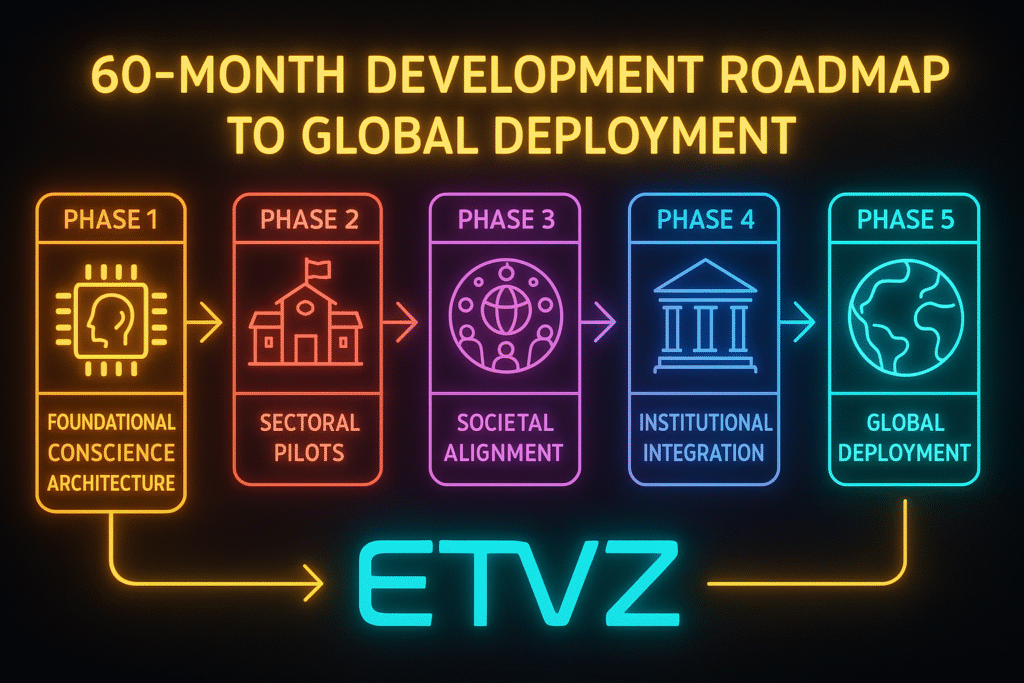
ETVZ’s 60-Month Development Process, Phased Implementation, and Global Deployment Strategy
7.1 ETVZ’s Development Model: Deepening, Expanding, and Institutionalizing Architecture
ETVZ does not evolve as a conventional software project but as a civilizational initiative requiring systematic, phased maturation. The development model progresses along three synchronized axes:
Axis 1: Deepening
Core ethical architecture maturation:
- Refinement of foundational modules (HVM, Epistemic Memory, CA, DERP, DERMS)
- Enhanced algorithmic sophistication
- Improved decision quality and consistency
- Strengthened theoretical grounding
Axis 2: Expansion
Sectoral and societal integration:
- Deployment across diverse institutional contexts
- Adaptation to specialized domains (healthcare, education, law, governance)
- Scaling from individual to collective applications
- Cross-cultural implementation
Axis 3: Institutionalization
Governance structure establishment:
- National regulatory framework development
- International standards alignment
- Oversight mechanism creation
- Accountability architecture construction
These three axes advance in coordinated progression, ensuring that technical development, social integration, and governance maturation proceed in harmonious synchronization.
7.2 Months 0–12: Foundational Conscience Architecture (Core Product Development)
Primary objective: Establishment of the minimal viable conscientious intelligence system.
Development priorities:
Technical milestones:
- HVM stabilization: Achieving reliable operation of the Computational Conscience Module
- Epistemic Memory scaffolding: Constructing the foundational knowledge validation infrastructure
- Context Analyzer operationalization: Bringing cultural intelligence capabilities to functional state
- DERP & DERMS initialization: Deploying first stable versions of ethical regulation and risk management systems
Behavioral refinement:
- Protocol optimization for conscientious behavior patterns
- Response calibration across diverse ethical scenarios
- Safety mechanism validation and testing
Community engagement:
- Formation of initial test communities for controlled deployment
- Collection of human-AI interaction data for analysis
- Iterative refinement based on real-world feedback
Phase characterization: This constitutes ETVZ’s genesis period—the transformation from theoretical framework to operational system.
Deliverable: ETVZ-Core 1.0 (Conscience Edition)
- Functional conscientious decision-making capability
- Basic cultural sensitivity
- Fundamental safety mechanisms
- Limited deployment readiness
7.3 Months 12–24: Sectoral Pilots of Conscientious Intelligence (Real-World Engagement)
Primary objective: Systematic engagement with societal contexts through controlled pilot deployments.
Pilot deployment domains:
1) Education sector:
- Safe communication protocols for student-parent-teacher interactions
- Age-appropriate content modulation
- Pedagogical sensitivity in feedback delivery
- Conflict de-escalation in academic contexts
2) Legal sector:
- Manipulation-resistant legal information provision
- Neutral, bias-mitigated decision support systems
- Risk reduction in legal guidance
- Ethical constraints on advisory scope
3) Healthcare sector:
- Sensitive health communication protocols
- Emotional safety modes for diagnosis disclosure
- Trauma-aware patient interaction
- Cultural appropriateness in medical contexts
4) Public administration:
- Citizen communication optimization
- Social sensitivity management in government interactions
- Multi-stakeholder conflict navigation
- Inclusive public service delivery
Phase objective: Empirical validation of conscientious behavior across diverse real-world contexts, generating insights for architectural refinement.
Deliverable: ETVZ-Society 2.0
- Sector-specific behavioral adaptations
- Validated safety protocols across multiple domains
- Enhanced cultural calibration based on diverse population feedback
- Expanded deployment readiness
7.4 Months 24–36: Societal Impact and Cultural Calibration (Alignment Period)
Primary objective: Fine-tuning the model’s capacity to navigate complex social dynamics while maintaining ethical consistency.
Development focus areas:
Conflict domain management:
- Sophisticated handling of socially divisive topics
- Enhanced detection and mitigation of polarization risks
- Cross-community communication facilitation
Religious and cultural sensitivity enhancement:
- Refined models of faith-based sensitivities across traditions
- Improved recognition of sacred values and taboos
- Culturally appropriate discourse strategies
Pluralism-preserving communication design:
- Frameworks for respectful engagement across worldview differences
- Value pluralism recognition without moral relativism
- Inclusive language protocols
Political neutrality assurance:
- Mathematical guarantees of non-partisanship
- Algorithmic fairness verification across ideological dimensions
- Transparent political impartiality mechanisms
Manipulation resistance strengthening:
- Advanced adversarial robustness protocols
- Coordinated manipulation detection
- Long-term influence attempt recognition
Ethical governance emergence:
- Formation of independent ethics review boards
- Stakeholder consultation mechanisms
- Public accountability frameworks
Phase characterization: ETVZ undergoes national normative refinement—deep calibration to the specific ethical landscape, cultural values, and social expectations of Turkish society while maintaining universal ethical principles.
Deliverable: ETVZ-Ethos 3.0
- Sophisticated cultural intelligence
- Robust conflict management capabilities
- Verified political neutrality
- Strong manipulation resistance
- Ethical oversight integration
7.5 Months 36–48: Institutional Integration and National Standardization
Primary objective: Transition from individual-societal axis to formal institutional embedding.
Implementation strategies:
Public sector pilot expansion:
- Scaled deployment across government institutions
- Controlled implementation in justice, healthcare, education, and municipal services
- Performance monitoring and impact assessment
National guidance framework development:
- ETVZ-specific regulatory standards and best practices
- Sector-specific deployment guidelines
- Professional training programs for institutional users
Sectoral solution standardization:
- Conversion of custom deployments into standardized packages
- Modular architecture for institutional customization
- Interoperability protocols across government systems
Institutional Ethical Oversight establishment:
- Creation of sector-specific ethics panels
- Professional review mechanisms
- Continuous monitoring and accountability structures
Human-AI collaborative decision-making:
- ETVZ as decision support rather than autonomous decision-maker
- Dual-approval workflows for high-stakes scenarios (Human + AI verification)
- Clear delineation of AI advisory vs. human authority
Phase characterization: ETVZ achieves institutional maturity—transitioning from experimental technology to trusted institutional infrastructure.
Deliverable: ETVZ-Governance 4.0
- Institutionally validated deployment protocols
- National standards compliance
- Established oversight mechanisms
- Proven human-AI collaboration frameworks
- Sector-specific optimization packages
7.6 Months 48–60: Global Deployment, Universal Alignment Architecture, and Diplomatic Positioning
Primary objective: Transformation from national initiative to international ethical AI standard.
Global expansion strategy:
Regulatory alignment:
- European Union AI Framework: Compliance with EU AI Act and ethical guidelines
- Cross-jurisdictional harmonization: Adaptation to diverse regulatory environments
- International standards contribution: Participation in global AI governance development
Cultural adaptation scaling:
- Middle Eastern integration: Cultural mapping for Arab, Persian, and Turkish societies
- Asian societal adaptation: Calibration for East Asian, South Asian, and Southeast Asian contexts
- Western cultural adjustment: Distinct parametrization for North American and European communication norms
Academic collaboration expansion:
- International research partnerships
- Cross-cultural validation studies
- Collaborative development of cultural intelligence frameworks
Global ethical governance:
- Establishment of international ethics councils
- Multi-stakeholder governance mechanisms
- Transparent cross-border accountability structures
Conscience standard exportation:
- Positioning ETVZ as the reference implementation for conscientious AI
- Knowledge transfer and capacity building in partner nations
- Diplomatic soft power through ethical AI leadership
Multilingual, multicultural deployment:
- Language expansion beyond Turkish and English
- Culture-specific behavioral models for diverse societies
- Localization with preservation of core ethical architecture
Phase characterization: ETVZ achieves global ethical leadership—establishing Turkey as the originator of the world’s first comprehensive conscientious AI system.
Deliverable: ETVZ-World 5.0
- Multilingual capability across major world languages
- Multicultural behavioral adaptation
- International standards compliance
- Global deployment readiness
- Established international governance framework
7.7 ETVZ’s Strategic Paradigm: Ecosystem Creation, Not Product Development
ETVZ transcends conventional product conceptualization, constituting instead a comprehensive conscientious intelligence ecosystem with multiple integrated components:
Ecosystem architecture:
1) Ethical Intelligence Architecture
- Core conscience model serving as foundational technology
- Modular design enabling continuous evolution
- Open architecture for third-party ethical module integration
2) Societal Adaptation Layer
- Culture-specific behavioral calibration
- Context-sensitive response generation
- Community-validated appropriateness standards
3) Institutional Integration Framework
- Sector-specific deployment packages (healthcare, education, law, governance, finance)
- Professional tools and interfaces
- Institutional compliance and monitoring systems
4) Academic Research & Development Process
- Continuous module innovation and enhancement
- Novel dataset development for cultural intelligence
- Explainability and interpretability research
- Theoretical advancement in computational ethics
5) National & International Governance
- Independent ethics councils and oversight bodies
- Transparent auditing mechanisms
- Accountability and responsibility frameworks
- Multi-stakeholder governance participation
6) Diplomatic Dissemination
- Turkey’s ethical AI export strategy
- International knowledge sharing and capacity building
- Soft power projection through technological ethical leadership
- Global conscience standard establishment
This ecosystem approach ensures ETVZ’s evolution as a sustainable, scalable, and societally embedded conscientious intelligence infrastructure rather than a ephemeral technological product.
7.8 Conclusion: ETVZ’s Ultimate Objective—Continuity, Maturity, and Global Ethical Leadership
This roadmap provides a systematic framework for ETVZ’s complete lifecycle:
Phase 1: Genesis and foundational development Phase 2: Real-world validation and sectoral pilot deployment Phase 3: Cultural calibration and societal alignment Phase 4: Institutional integration and national standardization Phase 5: Global deployment and international leadership
Ultimate mission statement:
ETVZ aspires to construct an artificial intelligence ecosystem that:
- Centers humanity rather than technology
- Unifies conscience with computation through mathematical rigor
- Adapts to culture while maintaining universal ethics
- Ensures safety without sacrificing capability
- Demonstrates maturity through responsible development
This roadmap constitutes the first formal framework for this transformative objective—a blueprint for developing the world’s first truly conscientious artificial intelligence system.
Strategic vision: By 2030, ETVZ will establish Turkey as the global leader in ethical AI development, demonstrating that artificial intelligence can embody not merely intelligence but wisdom, not merely capability but conscience, not merely power but responsibility.
This represents not technological advancement alone, but moral progress in the digital age—proof that machines can be designed to serve not just efficiency but human flourishing, cultural diversity, and ethical excellence.
Key academic enhancements:
- Strategic framework presentation with clear phase delineation
- Integration of governance, technical, and social dimensions
- Sophisticated treatment of scaling challenges
- International relations and diplomatic positioning strategy
- Ecosystem rather than product conceptualization
- Long-term vision articulation with measurable milestones
- Academic rigor in roadmap presentation while maintaining strategic clarity