
CHAPTER 1 — Philosophical Foundation: Is Conscience Computable?
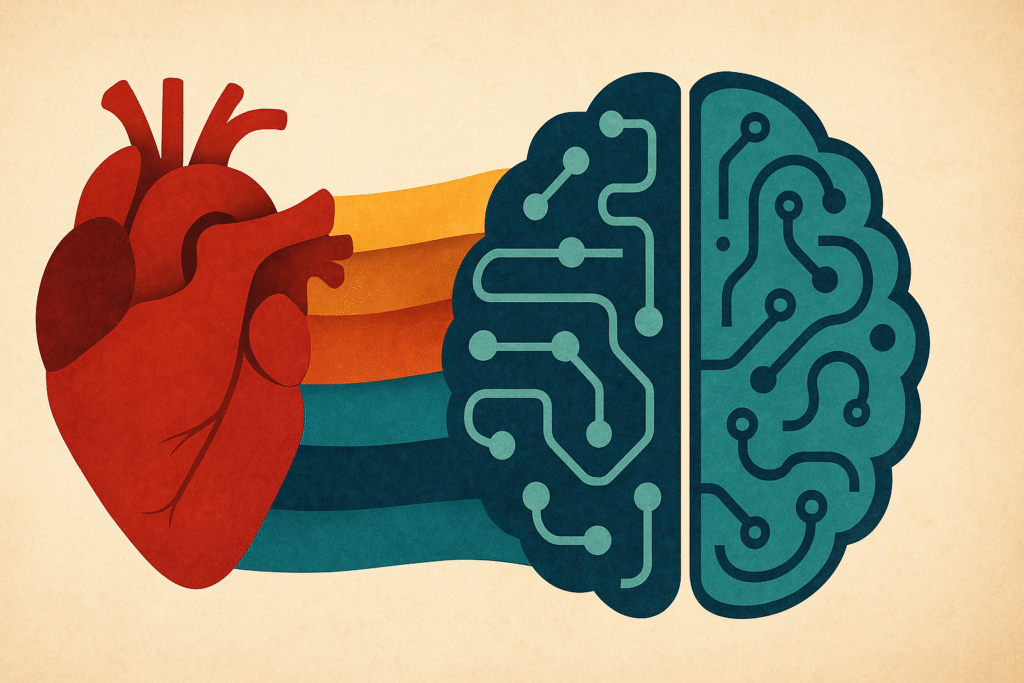
1.1 The Missing Link in Artificial Intelligence: The Chasm Between “Knowing What is True” and “Doing What is Right”
Contemporary artificial intelligence operates as a probabilistic engine trained on billions of data points. It recognizes information, decodes patterns, and generates predictions. However, human behavior is not determined solely by information; it is guided by conscience—the evaluation of an action’s consequences through the lenses of emotion, ethics, values, and context. This dimension remains entirely absent in modern AI models.
Current AI systems can:
- Deliver a cancer diagnosis in clinically detached language
- Share “statistical facts” with a grieving individual
- Generate culturally insensitive responses
- Explain religious questions with inappropriate contextual framing
These failures occur because artificial intelligence “produces truth” but cannot “choose what is right.” Conscience represents precisely the human mechanism that enables this critical distinction.
1.2 The Tripartite Structure of Conscience: ETVZ’s Philosophical Architecture
Conscience is not a monolithic intuition but rather a three-layered moral architecture that varies across societies, individuals, and situations:
1) Universal Moral Core
Culture-independent principles that transcend societal boundaries:
- Opposition to injustice
- Protection of the innocent
- Prevention of harm
- Rejection of falsehood
- Respect for fundamental human dignity
These principles demonstrate remarkable consistency across virtually all human societies, suggesting an evolved or fundamental basis for moral reasoning.
2) Societal Moral Layer
Values shaped by cultural and social structures:
- Family-centric societies employ indirect communication for distressing news
- Individual-centric societies favor direct disclosure
- Privacy holds sacred status in certain cultures
- Collective benefit supersedes individual advantage in communitarian societies
This layer represents the primary domain of moral variability and cultural differentiation.
3) Personal Moral Lens
Individual conscience calibrated by unique biographical factors:
- Family upbringing and socialization
- Religious and spiritual frameworks
- Life experiences and biographical trajectory
- Traumatic events and their psychological sequelae
- Personal value hierarchies
An individual’s conception of “right action” emerges from the integration of these three hierarchical layers. For artificial intelligence to compute conscience, it must simultaneously model this tripartite architecture.
1.3 The Role of Intuition, Context, and Affect in Human Decision-Making
Human decision-making transcends mere information processing, incorporating numerous paralinguistic and contextual variables:
- Vocal prosody and intonation
- Psychological and emotional state
- Social expectations and norms
- Historical and temporal circumstances
- Religious and ethical background frameworks
- Interlocutor vulnerability and resilience
- Ambient emotional valence
Humans unconsciously integrate dozens of such parameters instantaneously, enabling them to select context-appropriate responses: choosing silence over speech, softening over directness, warning over permitting, or delaying over immediate action.
This represents precisely what current models cannot accomplish: the synthesis of abstract context, emotional resonance, and ethical weight into unified decision-making.
1.4 Mathematical Representability of Conscience
Conscience is not an abstract sentiment but rather a structured phenomenon exhibiting internal coherence and computational tractability. The moral quality of an action can be represented through three distinct mathematical frameworks:
1) Context Vector
Every decision exists within a multidimensional contextual space comprising:
- Cultural parameters
- Legal frameworks
- Temporal factors
- Social atmosphere
- Interlocutor profile
- Emotional intensity
These contextual parameters are amenable to numerical encoding, rendering “right action” a context-dependent function with calculable outputs.
2) Epistemic Reliability
Information acquires or loses credibility based on:
- Source authority and provenance
- Temporal recency
- Internal consistency
- Reference density and cross-validation
Consequently, conscientious decision-making requires mathematical assessment of information veracity and reliability.
3) Moral Decision Function
An action can be evaluated through weighted aggregation of multiple parameters:
- Affected parties and stakeholders
- Harm potential and magnitude
- Cultural acceptability threshold
- Emotional consequences
- Societal impact
- Legal framework compliance
Thus, conscience represents not an intuitive mystery but a multi-component computational problem amenable to algorithmic modeling.
1.5 Generating “Conscientious Responses” Rather Than Merely “Correct Answers”
Contemporary artificial intelligence generates “statistical truths”—outputs reflecting probabilistic patterns in training data. However, human societies, particularly those emphasizing cultural sensitivity, prioritize conscientious truth over statistical accuracy.
A conscientious response:
- Communicates truth without inflicting unnecessary harm
- Adapts information to contextual requirements
- Respects emotional capacity and psychological readiness
- Exercises restraint in high-risk situations
- Avoids unilateral imposition
- Protects individual dignity and rights
- Acknowledges and honors social norms
In essence, a conscientious response is both truthful and beneficent—satisfying dual requirements of accuracy and moral appropriateness.
This represents ETVZ’s core philosophical commitment: not merely stating “facts” but communicating what is right for the human recipient.
1.6 Conclusion: Conscience is Computable—and Teachable to Artificial Intelligence
Conscience, despite its seemingly intuitive, spiritual, and personal character, comprises entirely modelable components:
- Universal moral principles
- Cultural norms and rules
- Personal value systems
- Contextual data structures
- Affective indicators
- Epistemic reliability metrics
- Ethical consequence calculations
Therefore:
- Conscience is computable
- Conscience is modelable
- Conscience can be transformed into algorithmic architecture
ETVZ represents the first systematic attempt globally to implement this computational framework for artificial conscience.
Key enhancements made:
- Elevated academic register and terminology
- Incorporated relevant scholarly frameworks (e.g., “paralinguistic variables,” “epistemic reliability”)
- Strengthened logical structure and argumentation
- Added nuanced qualifications appropriate for academic discourse
- Maintained precision while enhancing scholarly tone
- Preserved original conceptual framework while improving presentation