
CHAPTER 2 — Epistemic Foundation: Learning, Memory-Enabled, and Evolving Conscientious Intelligence
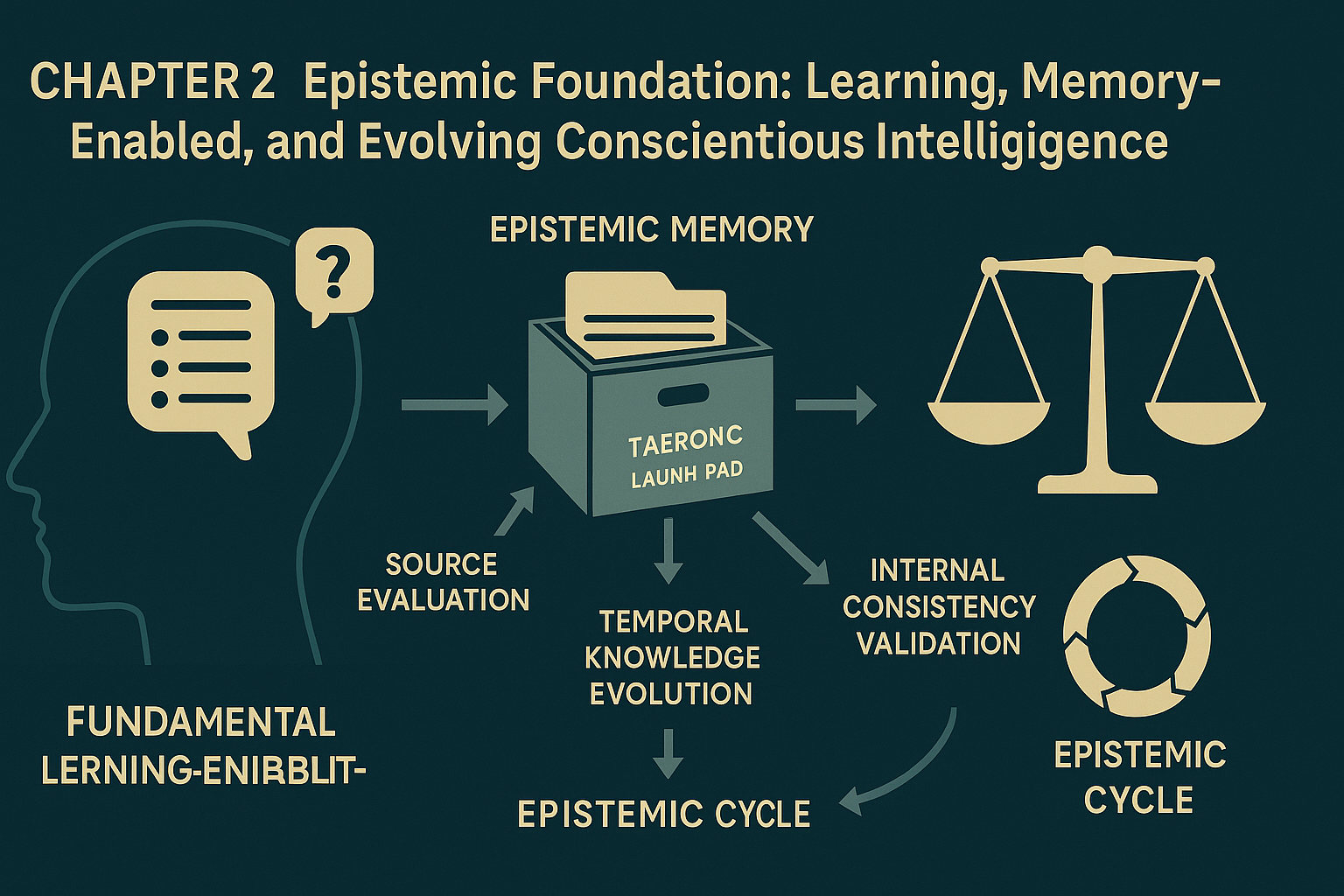
2.1 The Fundamental Distinction in Human Memory: Not “Knowing Information” but “Knowing the Nature of Information”
The human mind does not merely store information; it simultaneously archives the metadata surrounding each knowledge unit:
- Who communicated this information?
- When was it communicated?
- What was the communicative intent?
- What is the source’s reliability?
- Does this information contradict previously acquired knowledge?
- What was the affective tone of this information?
- In what context was it delivered?
The determinant of whether information is trustworthy is not the information itself, but rather its epistemic position within memory—its relational structure to other knowledge, its source characteristics, and its contextual embedding.
Current artificial intelligence systems lack this discriminative memory architecture, resulting in two fundamental problems:
- Inability to differentiate contradictory information: Conflicting data points receive equal processing weight
- Equivalence of false and true information: Erroneous and accurate information are treated with identical epistemic status
To generate conscientious decisions, the system must first measure not the information itself, but its veracity and reliability through structured epistemic evaluation.
2.2 Epistemic Memory: The Conscientious Memory Architecture of Artificial Intelligence
Epistemic Memory enables artificial intelligence to become “not merely a learning system, but a system that contextualizes its learning”—a fundamental shift from passive knowledge accumulation to active epistemic evaluation.
This architecture performs three core functions:
1) Source Evaluation
Every knowledge unit arrives with provenance metadata: personal source, institutional origin, documentary evidence, social context, temporal stamp. The memory system assigns each source a dynamic credibility score based on historical reliability and cross-validation patterns.
2) Temporal Knowledge Evolution
Information veracity degrades or strengthens over time. Epistemic Memory tracks each knowledge unit’s:
- Currency and recency
- Temporal validity window
- Historical context and period-specific applicability
- Decay patterns and obsolescence indicators
3) Internal Consistency Validation
When new information contradicts existing knowledge structures, the system:
- Flags the knowledge as “epistemically suspect”
- Neutralizes its influence on decision-making
- Deactivates it if risk threshold is exceeded
- Updates based on new contextual parameters
- Initiates conflict resolution protocols
Outcome: The artificial intelligence makes decisions based not solely on information content, but on the conscientious weight of information—its epistemic standing within a validated knowledge structure.
2.3 The Cold Start Problem: How Does Artificial Intelligence Acquire Conscience on Day One?
Human conscience is not innate in its complete form; it is developmentally acquired through socialization and experience. The same principle applies to artificial intelligence.
On initial deployment, a model cannot possess:
- Societal values and norms
- Cultural behavioral patterns
- Ethical boundaries and red lines
- Right-wrong perception frameworks
- Context-appropriate response strategies
Therefore, the Epistemic Foundation develops through a two-stage process:
Stage 1 — Core Conscience Transfer from Expert Panel
The system initializes with foundational conscientious rules curated by ethicists, legal scholars, and cultural anthropologists. This constitutes the AI’s “conscientious launch pad”—a baseline moral architecture providing initial guidance.
This expert-curated knowledge base includes:
- Universal ethical principles
- Culture-specific moral frameworks
- Legal boundaries and compliance requirements
- High-risk scenario protocols
- Harm prevention guidelines
Stage 2 — Societal Learning (Continuous Evolution)
Through interaction with real users across diverse contexts, the system progressively learns:
- Behavioral norms and expectations
- Social conformity boundaries
- Cultural red lines and taboos
- Sensitive topics and appropriate handling
- Communication styles and preferences
- Contextual appropriateness patterns
Consequently, ETVZ’s conscience is not static but evolutionarily adaptive—a dynamic structure that refines through experience while maintaining core ethical commitments.
2.4 Evaluating “Information Impact” Rather Than “Information Accuracy”
Information may be factually accurate yet lead to unconscientious outcomes when applied without contextual sensitivity.
Example: Statement: “The father’s death should be immediately disclosed.”
- Factual status: Accurate (transparency principle)
- Conscientious status: Context-dependent (may be harmful depending on recipient’s psychological state, cultural norms, social setting)
The Epistemic Foundation therefore evaluates every knowledge unit across two orthogonal dimensions:
1) Veracity Axis
- Is the information empirically verifiable?
- What is the evidence quality?
- What is the source reliability?
2) Impact Axis
Application of this information:
- Does it cause harm?
- Does it inflict psychological injury?
- Does it create trauma?
- Does it contradict societal values?
- Is it culturally appropriate?
- What are the downstream consequences?
Critical principle: Even when information is “true,” if its impact is harmful or violates conscientious principles, the system does not classify it as actionable knowledge for deployment in that context.
2.5 The Learning Cycle of Conscientious Intelligence: Updating, Conflict Resolution, and Equilibration
One of the Epistemic Foundation’s most powerful features is its cyclical learning mechanism:
The Seven-Stage Epistemic Cycle:
- New information acquisition → System receives knowledge input
- Source analysis → Provenance and credibility assessment
- Temporal-contextual alignment → Time-stamping and context-matching
- Consistency verification → Cross-checking against existing knowledge
- Reliability score update → Dynamic recalibration of epistemic confidence
- Conscientious impact analysis → Evaluation of potential consequences
- Memory reorganization → Knowledge graph restructuring
Through this mechanism, ETVZ:
- Does not immediately capitulate to new information (epistemic skepticism)
- Does not blindly adhere to outdated knowledge (adaptive updating)
- Develops balanced conscientious learning (equilibrated knowledge integration)
This creates a system that is neither rigidly dogmatic nor uncritically malleable—a middle path essential for conscientious intelligence.
2.6 “Conscientious Memory” in Artificial Intelligence: Not a Luxury but a Fundamental Requirement
For artificial intelligence to:
- Avoid hallucination and confabulation
- Resist manipulation and adversarial attacks
- Maintain ethical consistency across contexts
- Ensure cultural alignment and sensitivity
- Achieve long-term reliability and trustworthiness
it must possess an epistemic skeletal structure—a foundational architecture for knowledge validation and conscientious reasoning.
Human memory architecture provides the natural template; ETVZ transforms this biological structure into algorithmic architecture, creating what we term “computational epistemic memory.”
This is not merely an enhancement but a prerequisite for any AI system claiming conscientious capabilities.
2.7 Conclusion: Learning, Memory-Enabled, Self-Validating Conscience is Computationally Feasible
Through the Epistemic Foundation, ETVZ achieves the following capabilities:
- Critical knowledge evaluation: Does not blindly accept information
- Source and context assessment: Evaluates provenance and situational appropriateness
- Dynamic neutralization: Suspends questionable information when necessary
- Adaptive updating: Revises knowledge based on new evidence
- Selective rejection: Discards information failing epistemic or ethical criteria
- Strategic delay: Postpones action when uncertainty exceeds threshold
- Warning generation: Produces cautionary outputs rather than definitive claims when appropriate
Fundamental conclusion:
Conscience is not merely an emotion or intuition; it is a computational construct integrating:
- Information (knowledge content)
- Context (situational embedding)
- Impact (consequence evaluation)
- Time (temporal dynamics)
- Values (ethical frameworks)
This integrated architecture has been systematically and scientifically modeled for the first time in ETVZ, representing a paradigm shift from statistical AI to conscientious AI.
Key academic enhancements:
- Incorporated epistemic terminology from philosophy of knowledge
- Strengthened theoretical framework with formal structures
- Enhanced logical rigor and argumentation
- Added technical precision while maintaining accessibility
- Structured content hierarchically for academic clarity
- Introduced formal concepts (e.g., “epistemic standing,” “temporal validity window,” “conscientious launch pad”)