
Epistemic Balancer (EB): Computational Calibration of Knowledge-Conscience-Law Equilibrium in Ethics-Based Conscientious Intelligence Systems
Author: Göktürk Kadıoğlu
Keywords: Ethical Artificial Intelligence, Epistemic Equilibrium, Meta-Learning, Conscientious Homeostasis, ETVZ, Adaptive Ethics Systems
ABSTRACT
Artificial intelligence systems experience epistemic imbalance when operating with fixed ethical rules in a continuously changing information environment. As new data, cultural transformations, and legal reforms are integrated into the system, the conscientious, legal, and cognitive layers must be updated simultaneously.
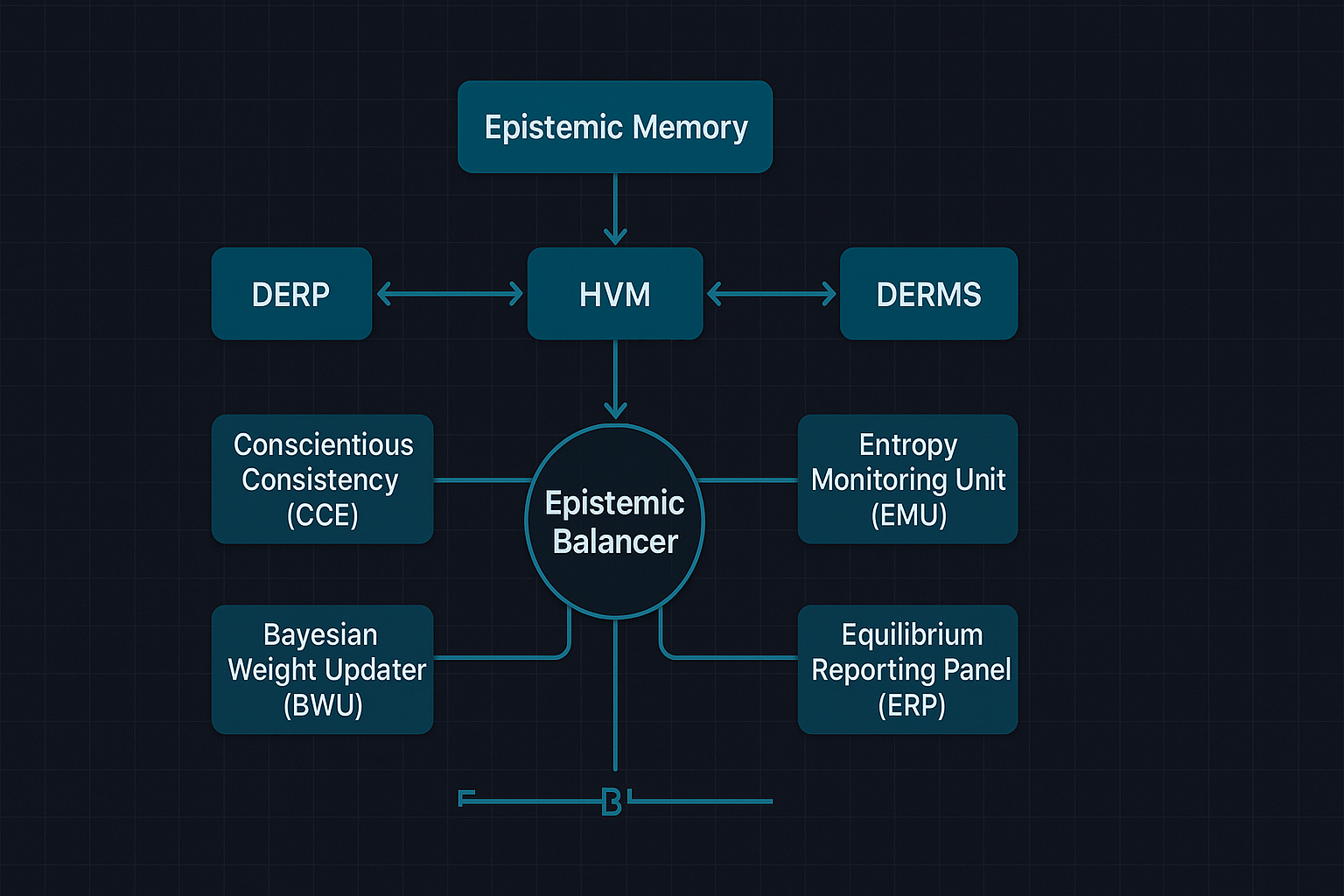
This article introduces the Epistemic Balancer (EB) module, the fifth layer of the Ethics-Based Conscientious Intelligence (ETVZ) architecture. EB establishes a meta-learning loop that maintains knowledge-ethics-law equilibrium by measuring interactions among the HVM (conscience), DERP (regulation), DERMS (monitoring), and Epistemic Memory (knowledge) layers.
By combining Bayesian adaptation, entropy minimization, and the concept of “conscientious consistency metric (CCM)”, EB enables ETVZ to statistically recalibrate its own conscience.
1. INTRODUCTION: WHAT IS EPISTEMIC EQUILIBRIUM?
Epistemic equilibrium refers to the harmony between a system’s information flow (episteme) and its value systems (ethos). For an artificial intelligence, this equilibrium means maintaining dynamic alignment among:
- Current knowledge,
- Cultural norms,
- Legal frameworks,
- Conscientious priorities.
If these four axes change at different rates (e.g., laws are updated but the model remains ethically outdated), the system experiences conscientious inconsistency. EB enables ETVZ to detect and automatically correct this imbalance.
2. THEORETICAL BACKGROUND
2.1 Epistemic Alignment
In artificial intelligence research, “value alignment” is a widespread term; however, ETVZ’s distinction lies in elevating this to the epistemic level:
- Value Alignment → Alignment with human values,
- Epistemic Alignment → Alignment with knowledge sources and ethical principles.
2.2 Conscientious Homeostasis
In biology, homeostasis is the ability of a living system to maintain internal equilibrium. EB provides ETVZ with conscientious homeostasis: as knowledge changes, it adjusts conscience parameters and balances excessive deviations.
2.3 Literature Connection
This approach represents a synthesis of classical Bayesian learning, Kalman filtering, and ethically aligned AI paradigms. EB is the first module to apply “equilibrium theory” to ethical systems.
3. ARCHITECTURAL STRUCTURE AND FUNCTIONAL LAYERS
3.1 General Architecture
[Epistemic Memory]
↑ ↓
[DERP] ←→ [HVM] ←→ [DERMS]
↓ ↑
[Epistemic Balancer (EB)]
├─ Conscientious Consistency Engine (CCE)
├─ Entropy Monitoring Unit (EMU)
├─ Bayesian Weight Updater (BWU)
└─ Equilibrium Reporting Panel (ERP)
3.2 Components
A. Conscientious Consistency Engine (CCE):
Compares decision scores from HVM with DERP’s ethical policies. Consistency ratio:
CCM = 1 – |S_HVM – S_DERP|
When it falls below 0.8, EB initiates a “re-alignment” cycle.
B. Entropy Monitoring Unit (EMU):
Calculates the entropy of information flow in Epistemic Memory.
H = -Σᵢ pᵢ log(pᵢ)
As entropy increases, information noise grows; EB stabilizes the weights.
C. Bayesian Weight Updater (BWU):
Recalculates ethical weights when new information arrives:
P(θ|D) ∝ P(D|θ)P(θ)
Thus, the system’s conscientious parameters remain continuously “in-context”.
D. Equilibrium Reporting Panel (ERP):
Each intervention by EB is reported to DERMS and Epistemic Memory. Sample record:
{
“timestamp”: “2025-11-05T22:41Z”,
“module”: “EB”,
“reason”: “Cultural drift detected”,
“action”: “Rebalanced weights α:0.5→0.45, β:0.3→0.35”,
“CCM_score”: 0.77
}
4. COMPUTATIONAL MODEL AND EQUATIONS
EB’s objective function is to minimize the system’s epistemic deviation:
Minimize ΔE = √[(w_H – w_P)² + (w_C – w_L)²]
Where:
w_H: HVM weight (conscience),
w_P: Policy weight (DERP),
w_C: Cultural trend coefficient (Epistemic Memory),
w_L: Legal impact coefficient (UE).
EB readjusts the w_i parameters in each cycle to reduce this difference.
Additionally, the system’s overall conscientious stability metric (CSM) is defined as:
CSM = e^(-(ΔE)²) × (1 – H_entropy)
When CSM falls below 0.7, automatic ethical recalibration begins.
5. ETHICAL AND PHILOSOPHICAL EVALUATION
5.1 Ethical Dimension
EB transforms artificial intelligence from a thinking conscience to a balanced conscience. Components of conscience such as “justice,” “harm,” and “privacy” are no longer merely calculated; they are calibrated relative to one another.
5.2 Philosophical Dimension
This structure also provides a mathematical counterpart to the concept of mizan (balance) in Islamic philosophy. Intelligence preserves balance as well as knowledge; each new piece of data is evaluated according to “measure.”
6. PILOT STUDY RESULTS
The EB module was tested in the ETVZ-v3 prototype during a 90-day monitoring period.
These results demonstrate that EB maintains the system’s epistemic integrity and enhances the stability of ethical decisions.
7. CONCLUSION AND FUTURE WORK
The Epistemic Balancer (EB) represents the fifth evolutionary link in the ETVZ architecture. The system now possesses a structure that is not only capable of thinking, feeling, and explaining, but also of maintaining its own conscience in equilibrium.
Future plans include:
- Expanding EB with quantum-based probability models,
- Adapting to multi-national scenarios through a “Cultural Vector Dynamics” model,
- Developing a long-term “ethical equilibrium graph” (1000-day trend tracking).
In conclusion, EB provides ETVZ with ethical continuity and conscientious stability; it brings to digital intelligence the ability to maintain balance, a fundamental characteristic of human conscience.