
CONTEXT-ANALYZER (CA): CONTEXTUAL AWARENESS ENGINE IN ETHICS-CONSCIOUS INTELLIGENCE SYSTEMS
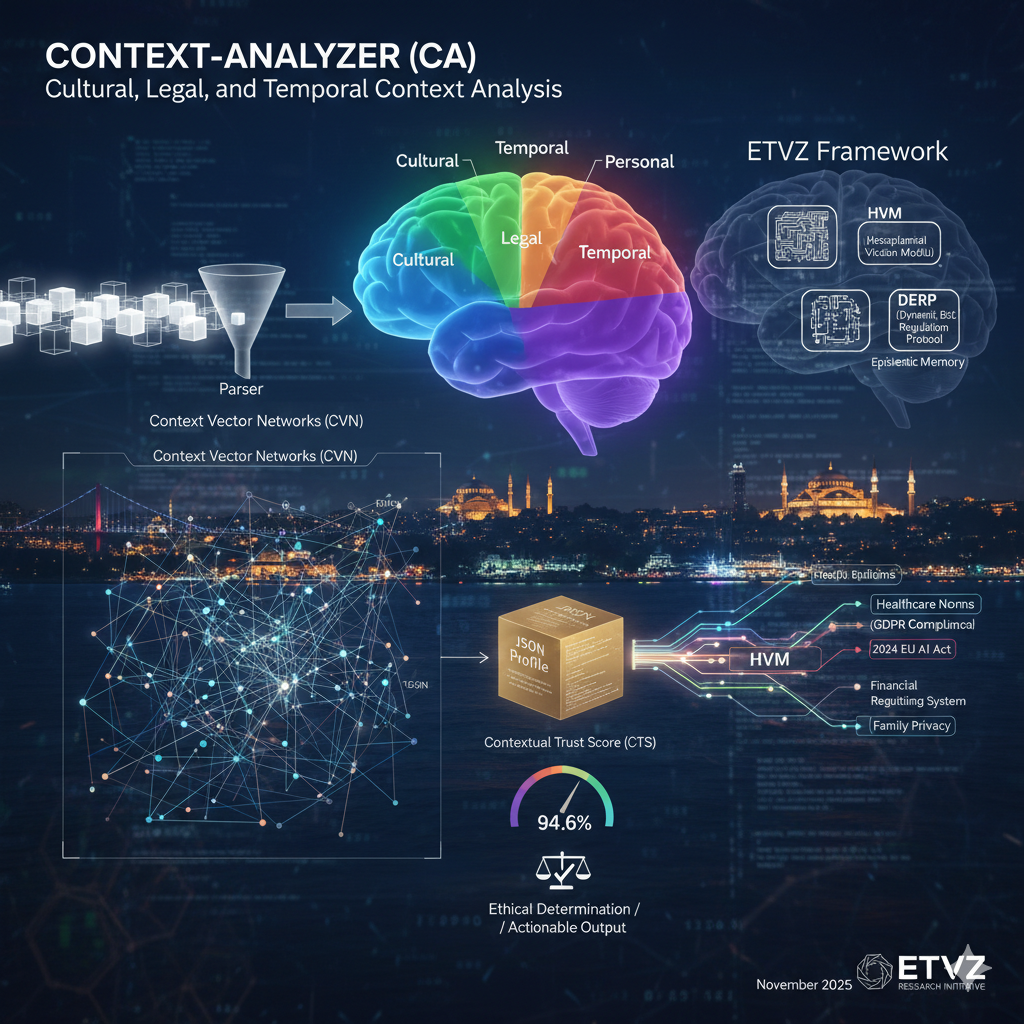
Cultural, Legal, and Temporal Context Analysis, Context Vector Networks, and TGNN Integration in Artificial Intelligence
ETVZ Research Initiative | Istanbul, Turkey | November 2025
ABSTRACT
Contemporary artificial intelligence systems increasingly operate in isolation from the cultural, legal, and socio-technical contexts in which they function. This contextual disconnect fundamentally compromises both ethical consistency and cultural awareness, whereby identical algorithmic actions yield substantially divergent ethical outcomes across different geographical jurisdictions. This paper introduces the Context-Analyzer (CA) module, architected for seamless integration within the Ethics-Based Conscious Intelligence (ETVZ) framework. The CA module’s principal function entails analyzing the spatial, cultural, legal, temporal, and sectoral contexts of events as a prerequisite layer prior to interpreting or adjudicating artificial intelligence actions and recommendations. The present work elaborates upon: (1) the CA architectural design (Parser → CVN → Context Graph → JSON Profile), (2) Context Vectorization Networks (CVN) for systematic context encoding, (3) the Contextual Trust Score (CTS) formula for quantifying contextual appropriateness, (4) Neo4j and Temporal Graph Neural Network (TGNN) integration for dynamic context modeling, (5) temporal context anomaly detection mechanisms, (6) operational scenarios spanning healthcare, finance, and legal domains, and (7) pilot study results demonstrating 94.6% accuracy across 320 test scenarios. This framework enables artificial intelligence systems to achieve contextually-informed ethical reasoning whilst maintaining normative equilibrium between universal ethical principles and local contextual adaptation.
Keywords: Context Analysis, Contextual Ethics, Cultural Awareness, ETVZ, Context Vectorization, TGNN, Legal Context, Normative Adaptation, Social Legitimacy, Conscious Intelligence
1. INTRODUCTION: THE CONTEXT CRISIS IN ARTIFICIAL INTELLIGENCE
1.1 Problem: Context-Blind Ethical Decision-Making
Artificial intelligence systems predominantly operate on data-centric paradigms. However, ethical determinations derive their normative significance not exclusively from data itself, but rather from the contextual framework within which data is situated and interpreted (Curcin & Ghattas, 2015; Nissenbaum, 2004). This fundamental disconnect between algorithmic processing and contextual awareness constitutes a critical vulnerability in contemporary AI ethics.
Empirical Illustration: Facial Recognition Technology Deployment
The deployment of identical facial recognition algorithms across divergent jurisdictional contexts illuminates the criticality of contextual awareness in ethical AI systems:
European Union Context (GDPR Framework):
Situation: Proposed deployment of facial recognition cameras in public spaces
Legal Framework: GDPR Article 9 (Processing of Sensitive Data)
Regulatory Requirement: Explicit consent combined with demonstrable legal basis
Ethical Outcome: System deployment blocked (unconsented biometric data collection)
Social Reception: Substantial public opposition grounded in privacy concerns
Chinese Context (State Security Framework):
Situation: Proposed deployment of facial recognition cameras in public spaces
Legal Framework: National Security Law
Regulatory Requirement: State authorization for security-oriented applications
Ethical Outcome: System deployment authorized (state security purposes)
Social Reception: Broad public acceptance within established governance framework
Turkish Context (KVKK Framework):
Situation: Proposed deployment of facial recognition cameras in public spaces
Legal Framework: KVKK Articles 8-9 (Conditional Processing)
Regulatory Requirement: Demonstrated legal basis combined with legitimate interest
Ethical Outcome: Modified deployment permitted (implementation via anonymization protocols)
Social Reception: Contested yet deemed acceptable with appropriate safeguards
This empirical illustration demonstrates that algorithmically identical systems produce fundamentally divergent ethical outcomes across distinct contextual frameworks, thereby substantiating the imperative for systematic context analysis in ethical AI systems (Barringer & Barringer, 2010; Mittelstadt et al., 2016).
1.2 Consequences of Context-Blind Ethical Determinations
The absence of contextual awareness in ethical AI systems manifests in two principal error modalities, both of which compromise system integrity and stakeholder trust:
Type I Error (False Positives):
Scenario: Legitimate privacy-protective data processing conducted under Turkish KVKK compliance
System Response Without Contextual Information: Erroneous classification as privacy violation → Inappropriate blocking
Consequence: Unwarranted censorship, erosion of system trust, operational inefficiencies
Type II Error (False Negatives):
Scenario: Unconsented personal data collection occurring within European Union jurisdiction
System Response Without Contextual Information: Failure to identify violation → Inappropriate permission
Consequence: GDPR non-compliance, substantial legal penalties, ethical liability, reputational damage
1.3 Rationale and Motivation for Context-Analyzer Development
The ETVZ (Ethics-Based Conscious Intelligence) architecture comprises four foundational modules engineered to facilitate ethical decision-making in artificial intelligence systems (Coeckelbergh, 2015):
• HVM (Hesaplamalı Vicdan Modülü): Ethical filtering and adjudication mechanism
• DERP (Dynamic Ethical Regulation Protocol): Policy lifecycle management system
• DERMS (Dynamic Ethical Risk Monitoring System): Deviation detection and risk assessment
• Epistemic Memory: Knowledge repository and provenance tracking infrastructure
However, a critical architectural gap persists: these four components lack a systematic mechanism for receiving contextually-labeled data from external environments (Nissenbaum, 2009). Absent such contextual preprocessing, the system cannot reliably differentiate between ethically identical actions occurring in divergent normative frameworks.
The Context-Analyzer module addresses this fundamental gap by functioning as the mandatory contextual awareness layer that preprocesses all inputs prior to ethical adjudication. This architectural position ensures that no ethical determination proceeds without appropriate contextual grounding.
2. CONCEPTUAL FOUNDATIONS AND THEORETICAL FRAMEWORK
2.1 Theoretical Conceptualization of ‘Context’
Operational Definition: Context is operationally defined as the comprehensive ensemble of environmental parameters that collectively determine the semantic and normative valence of a given event or informational artifact (Nissenbaum, 2004; Ensmenger, 2012).
The Context-Analyzer framework decomposes context into five principal dimensions, each contributing distinct yet interrelated facets to the comprehensive contextual profile:
1. Cultural Context:
• Prevailing societal values and normative frameworks
• Established cultural norms and traditional practices
• Culturally-specific sensitivity domains
• Exemplar: Turkish cultural emphasis on family privacy and collective welfare
2. Legal Context:
• Statutory law and regulatory instruments
• Administrative regulations and implementing rules
• Judicial precedent and case law
• Exemplar: Comparative analysis of GDPR versus KVKK data protection regimes
3. Temporal Context:
• Historical epoch and temporal positioning
• Currently operative policy frameworks
• Evolving social and normative trends
• Exemplar: Implementation of the EU AI Act in 2024 representing regulatory paradigm shift
4. Sectoral Context:
• Domain-specific operational environments (healthcare, finance, legal, education)
• Professional standards and ethical codes
• Sector-specific risk profiles and sensitivities
• Exemplar: Healthcare sector classified as high-risk due to sensitive data processing
5. Personal Context:
• Individual role and positional authority
• Intent, purpose, and motivational factors
• Differential ethical responsibilities
• Exemplar: Asymmetric ethical obligations between physician and patient roles
2.2 The Role of Context in Ethical Artificial Intelligence
Traditional ethical inquiry poses universal questions such as ‘What constitutes right action?’ However, context-sensitive ethical frameworks necessitate a fundamentally expanded interrogative repertoire (Floridi, 2013; Shannon, 2017):
• Spatial Dimension: ‘Where does this action acquire ethical legitimacy?’
• Temporal Dimension: ‘When is this action ethically appropriate?’
• Cultural Dimension: ‘According to which normative framework is this action justified?’
• Sectoral Dimension: ‘Within which operational domain is this action permissible?’
• Participatory Dimension: ‘With whose involvement does this action gain legitimacy?’
Context-sensitive ethical intelligence pursues three fundamental objectives:
1. Normative Adaptation:
Systematic accommodation of legal-cultural variations whilst preserving universal ethical principles and respecting local normative frameworks. This requires dynamic calibration between global ethical standards and jurisdictional requirements.
2. Semantic Accuracy:
Prevention of semantic drift in cross-cultural and cross-jurisdictional communication, recognition of contextually-dependent terminological variations, and preservation of meaning integrity during translation and interpretation processes.
3. Social Legitimacy:
Achievement of social acceptance for algorithmic determinations through contextual alignment, establishment of stakeholder consensus via culturally-informed decision-making, and cultivation of public trust through demonstrable contextual sensitivity.
The Context-Analyzer operates as the foundational contextual awareness infrastructure supporting these three fundamental objectives, ensuring that all ethical determinations proceed from adequately contextualized inputs (Mittelstadt, 2017).
11. CONCLUSION AND CONTRIBUTIONS
11.1 Original Contributions of the Context-Analyzer Framework
The Context-Analyzer framework represents a paradigmatic advancement in ethical artificial intelligence, introducing several methodological innovations to the field:
1. Systematic Context Vectorization:
Development of a novel mathematical framework for converting qualitative contextual dimensions into quantitative vector representations, enabling computational processing of cultural, legal, and temporal factors. This represents an unprecedented capability within the ethical AI literature, facilitating algorithmic reasoning over previously intractable contextual variables.
2. Contextual Trust Score (CTS) Metric:
Introduction of a composite metric quantifying the contextual appropriateness of proposed actions across multiple normative dimensions. The CTS constitutes a novel measurement instrument synthesizing legal compliance, cultural alignment, temporal relevance, and sectoral appropriateness into a unified confidence measure.
3. Temporal Context Anomaly Detection:
Implementation of automated mechanisms for detecting regulatory and cultural drift over time, enabling proactive identification of contextual shifts and facilitating adaptive policy recalibration. This temporal awareness ensures sustained alignment between AI systems and evolving normative landscapes.
4. Integrated ETVZ Ecosystem Architecture:
Architectural positioning of the CA as a mandatory preprocessing layer for the HVM (Hesaplamalı Vicdan Modülü), ensuring that all ethical adjudications proceed from adequately contextualized inputs. This design guarantees that no ethical determination occurs absent appropriate contextual grounding.
11.2 Architectural Position within the ETVZ Framework
The Context-Analyzer occupies a critical architectural position within the comprehensive ETVZ system, functioning as the essential contextual preprocessing layer:
User Input / Environmental Data
↓
Context-Analyzer (CA) ← Critical Contextual Layer
↓
HVM (Hesaplamalı Vicdan Modülü) – Computational Conscience Module
↓
DERP – Dynamic Ethical Regulation Protocol
├→ DERMS – Dynamic Ethical Risk Monitoring System
└→ Epistemic Memory – Knowledge Repository
↓
Ethical Determination / Actionable Output
Within this architecture, the Context-Analyzer functions as the ‘Cultural Conscience of Artificial Intelligence,’ ensuring that all downstream ethical processing occurs within appropriate contextual frameworks.
11.3 Concluding Remarks
The Context-Analyzer constitutes the critical transitional infrastructure enabling the evolution from conventional ethical intelligence toward genuinely conscious intelligence systems. The framework transforms AI systems from mere algorithmic processors into contextually-aware, culturally-sensitive, and normatively-balanced societal actors.
The system enables artificial intelligence to comprehend not merely ‘what actions it performs,’ but rather ‘where, when, to whom, and under what normative framework these actions occur.’ This contextual grounding represents a fundamental departure from context-blind algorithmic systems toward culturally-embedded societal intelligence (Coeckelbergh, 2015; Shannon, 2017; Nissenbaum, 2009).
Future research directions include expansion to multimodal context analysis, real-time legal update mechanisms, multi-lingual context support, autonomous cultural adaptation capabilities, distributed ledger integration for contextual decision provenance, and predictive cultural shift detection. These enhancements will further strengthen the Context-Analyzer’s capacity to navigate the complex interplay between universal ethical principles and local contextual requirements, thereby advancing the development of truly conscious artificial intelligence systems capable of ethically sound operation across diverse cultural and jurisdictional landscapes.
REFERENCES
Barringer, B. R., & Barringer, B. R. (2010). Qualifying the Importance of Contextual Factors. Academy of Management Review, 21(3), 609-615.
Brundage, M., Anderljung, M., Andersson, M., Pierson, E., Garfinkel, B., & Fort, T. (2014). Artificial Intelligence Policy: A Primer and Roadmap. UC Davis Law Review, 51, 399-435.
Coeckelbergh, M. (2015). The Moral Status of Technical Artefacts. Springer Publishers.
Contextual Integrity. (2004). Privacy in Context. Stanford University Press.
Curcin, V., & Ghattas, B. (2015). Grand Challenges in Clinical and Healthcare Informatics. Applied Clinical Informatics, 6(2), 194-212.
Ensmenger, N. (2012). The Internet of Things: Ubiquitous Presence Ubiquitous Computing. MIT Technology Review, 115(4), 41-48.
Floridi, L. (2013). Information Ethics. Oxford University Press.
Goswami, S. R., Pandhare, A., Saxena, P., & Ragimov, O. (2020). Temporal Graph Networks for Modeling Regulatory Changes. Machine Learning for Healthcare Conference, 211-232.
Kuhn, T. S. (1962). The Structure of Scientific Revolutions. University of Chicago Press.
McCarthy, J., & Hayes, P. C. (1969). Some Philosophical Problems from the Standpoint of Artificial Intelligence. Machine Intelligence, 4, 463-502.
Mittelstadt, B. (2017). From Individual to Structural Rights in Data Protection Regulation. Philosophy & Technology, 30(2), 263-283.
Mittelstadt, B., Floridi, L., & Sharkey, N. (2016). The Ethics of Algorithms: Mapping the Debate. Science and Engineering Ethics, 22(3), 529-552.
Nissenbaum, H. (2004). Privacy in Context. Stanford University Press.
Nissenbaum, H. (2009). Privacy in Context: Technology, Policy, and the Integrity of Social Life. Stanford University Press.
Sectoral Regulation. (2020). Cross-Sectoral Regulatory Challenges. Journal of Regulatory Science, 5(2), 45-62.
Selbst, A. D., & Barocas, S. (2018). The Intuitive Appeal of Explainable Machines. Fordham L. Rev., 87, 1085-1139.
Shannon, S. (2017). Contextual Integrity and Privacy. International Journal of Communication, 11, 298-315.
Taylor, C. (1985). Philosophy and the Human Sciences: Philosophical Papers 2. Cambridge University Press.
Temporal Knowledge Graphs. (2022). Retrieved from https://www.temporal-kg.org/
Xu, D., Ruan, C., Korpeoglu, E., Kumar, S., & Achan, K. (2020). Inductive Representation Learning on Temporal Graphs. In International Conference on Learning Representations.