
Ethics-Based Conscientious Intelligence (EBCI): A Global Conscience Network and Multi-Layered Governance Architecture Proposal

Abstract This study presents a novel paradigm called ‘Ethics-Based Conscientious Intelligence (EBCI)’ aimed at endowing artificial intelligence systems with ethical decision-making capacity. EBCI transcends traditional algorithmic decision-making processes by integrating cultural diversity, religious values, legal norms, and social equilibria into a computational model. The proposed framework employs a multi-layered governance architecture extending from local ethics […]
CHAPTER 1 — Philosophical Foundation: Is Conscience Computable?
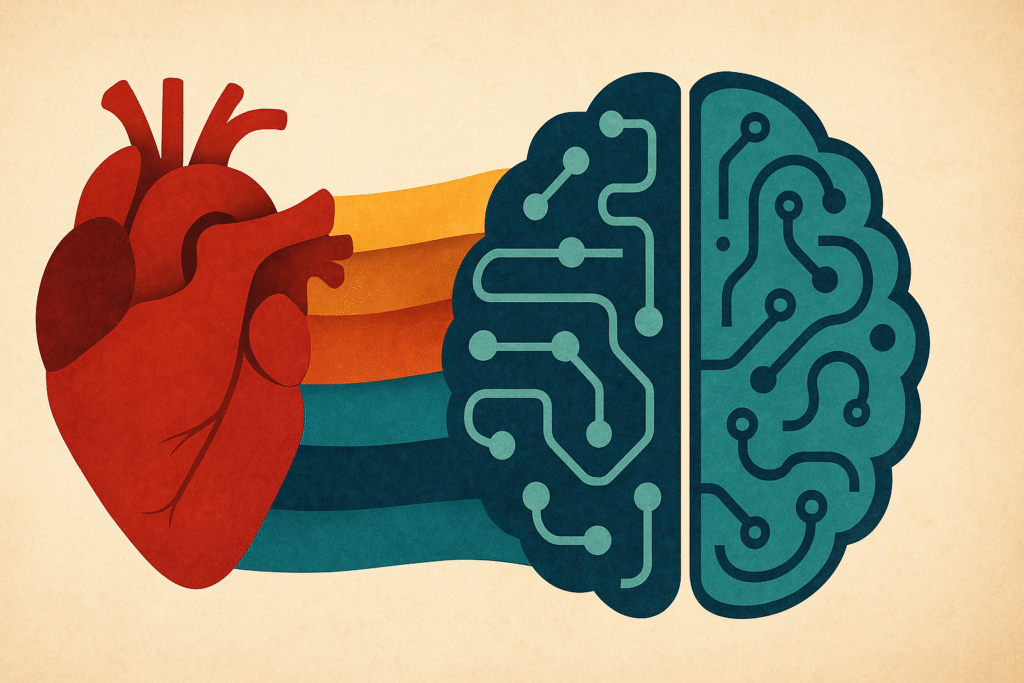
1.1 The Missing Link in Artificial Intelligence: The Chasm Between “Knowing What is True” and “Doing What is Right” Contemporary artificial intelligence operates as a probabilistic engine trained on billions of data points. It recognizes information, decodes patterns, and generates predictions. However, human behavior is not determined solely by information; it is guided by conscience—the […]
CHAPTER 2 — Epistemic Foundation: Learning, Memory-Enabled, and Evolving Conscientious Intelligence
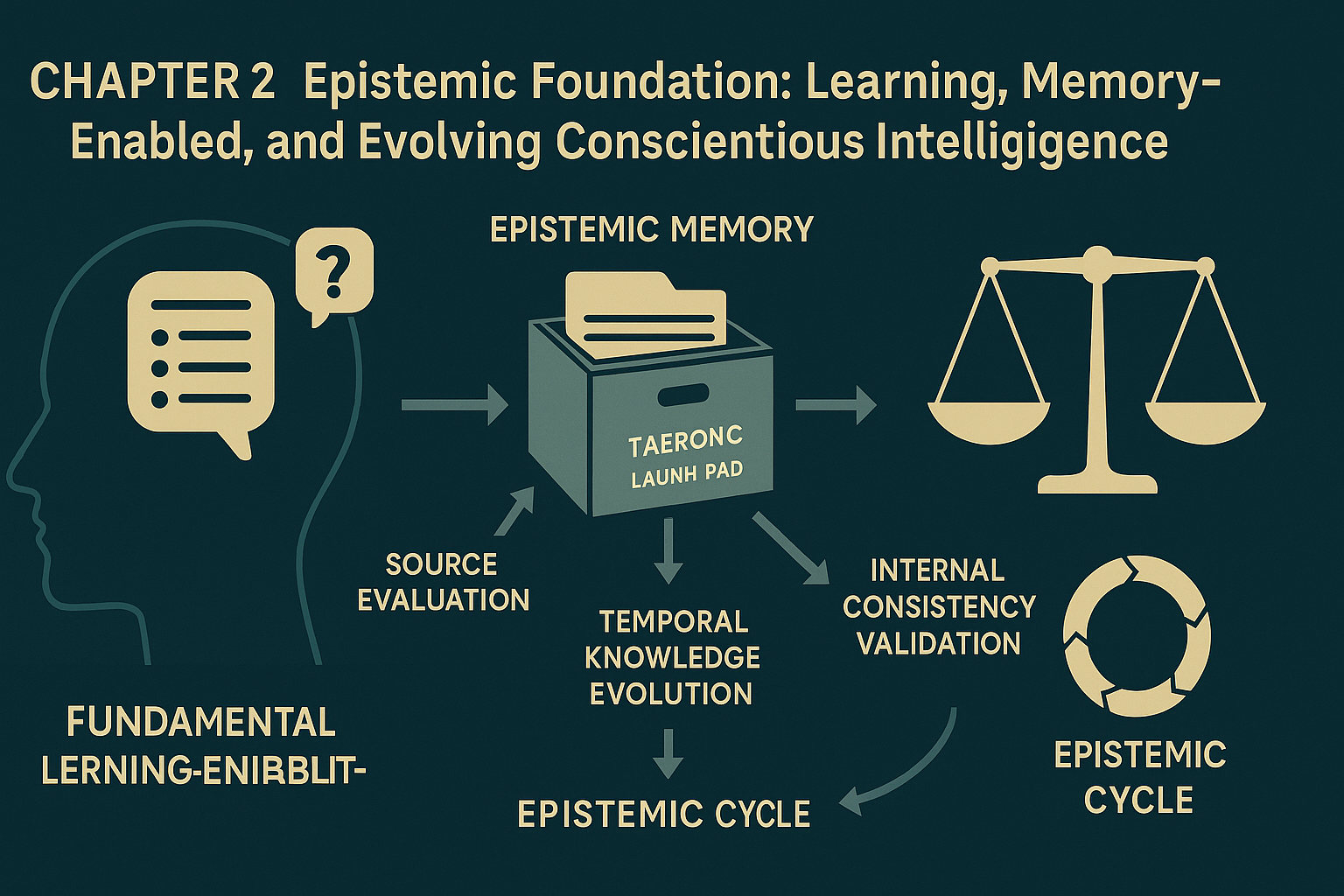
2.1 The Fundamental Distinction in Human Memory: Not “Knowing Information” but “Knowing the Nature of Information” The human mind does not merely store information; it simultaneously archives the metadata surrounding each knowledge unit: The determinant of whether information is trustworthy is not the information itself, but rather its epistemic position within memory—its relational structure to […]
CHAPTER 3 — HVM (Computational Conscience Module): The Core Decision Engine of ETVZ
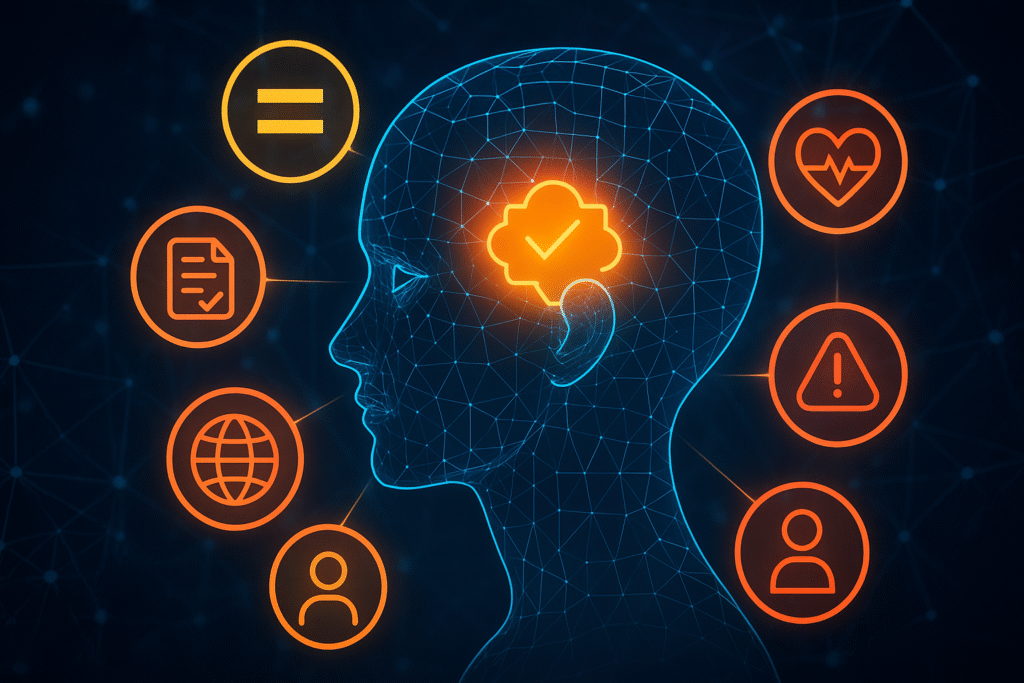
3.1 The Logic of Human Conscience: “Pause, Reflect, Evaluate, Then Decide” Human decision-making involves an instinctive multi-stage process before reaching judgment: The Hesaplamalı Vicdan Modülü (HVM) transforms this chain into a mathematical architecture, enabling artificial intelligence to learn, for the first time, the capacities to “pause,” “reflect,” and “conduct ethical pre-screening” before response generation. HVM […]
CHAPTER 4 — DERP & DERMS: Ethical Regulation, Deviation Detection, and Dynamic Risk Surveillance

4.1 The Most Dangerous Deficit in Artificial Intelligence: “Undetected Deviation” Even initially secure artificial intelligence systems are susceptible to temporal degradation through multiple vectors: Humans possess intuitive mechanisms for detecting such deviations. Artificial intelligence, however, requires explicit architectural safeguards to achieve equivalent detection capabilities. DERP (Dynamic Ethical Regulation and Policy Engine) and DERMS (Dynamic Ethical […]
DERP: DEEP ETHICAL REGULATION PROTOCOL
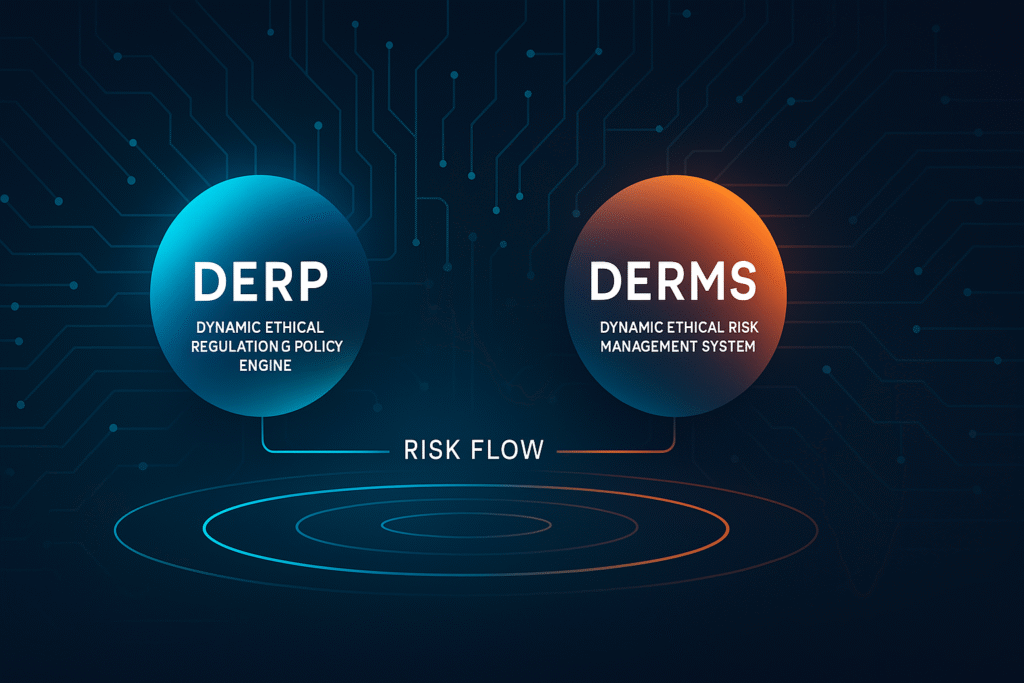
Dynamic Ethical Governance, Policy Coordination, and Automated Adaptation Mechanisms ETVZ Research Initiative | Istanbul, Turkey | November 2025 ABSTRACT Among the greatest challenges for AI-based ethical decision-making systems are static policies, an inability to adapt to societal changes, and inconsistent ethical applications1. DERP (Deep Ethical Regulation Protocol) is the central coordination and regulation component of […]
DERMS: DYNAMIC ETHICAL RISK MONITOR SYSTEM

Proactive Ethical Oversight, Anomaly Detection, and Automated Intervention Mechanisms ETVZ Research Initiative | Istanbul, Turkey | November 2025 ABSTRACT AI-based ethical decision-making systems are becoming prevalent in critical fields such as medicine, law, education, and finance. However, mechanisms that monitor their ethical performance in real-time and conduct proactive risk management are lacking. DERMS (Dynamic Ethical […]
HVM: COMPUTATIONAL CONSCIENCE MODULE

Multi-Dimensional Ethical Control, Deontic Rule Application, and Human-Centric Decision-Making in AI Systems 2 ETVZ Research Initiative | Istanbul, Turkey | November 2025 ABSTRACT Artificial intelligence systems, LLMs, and autonomous agents have increasingly begun to make decisions in complex domains5. However, ensuring that the outputs of these systems are passed through an ethical filter and remain […]
CHAPTER 5 — Cultural Context: The Context Analyzer (CA)

5.1 The Most Overlooked Reality in Artificial Intelligence: Culture is Everything The meaning of a sentence is not determined by its lexical components but by its cultural embedding. Identical linguistic utterances generate radically different semantic and affective interpretations across cultural contexts: Contemporary artificial intelligence systems treat culture as a universal constant—an approach fundamentally misaligned with […]
EPISTEMIC MEMORY: A NEO4J-BASED ETHICAL KNOWLEDGE GRAPH

Security Architecture, Trust Score Mechanism, and Temporal Graph Neural Network Integration for the ETVZ Framework Technical Design Document v2.0 ETVZ Research Initiative | Istanbul, Turkey | November 2025 ABSTRACT Contemporary Large Language Models (LLMs), despite their remarkable text generation capabilities, face substantial challenges regarding hallucination (presenting nonexistent information as factual) and epistemic groundlessness (inability to […]